
Solution 02 · Design engineering and production
Change management in production: changes arrive before anything is made
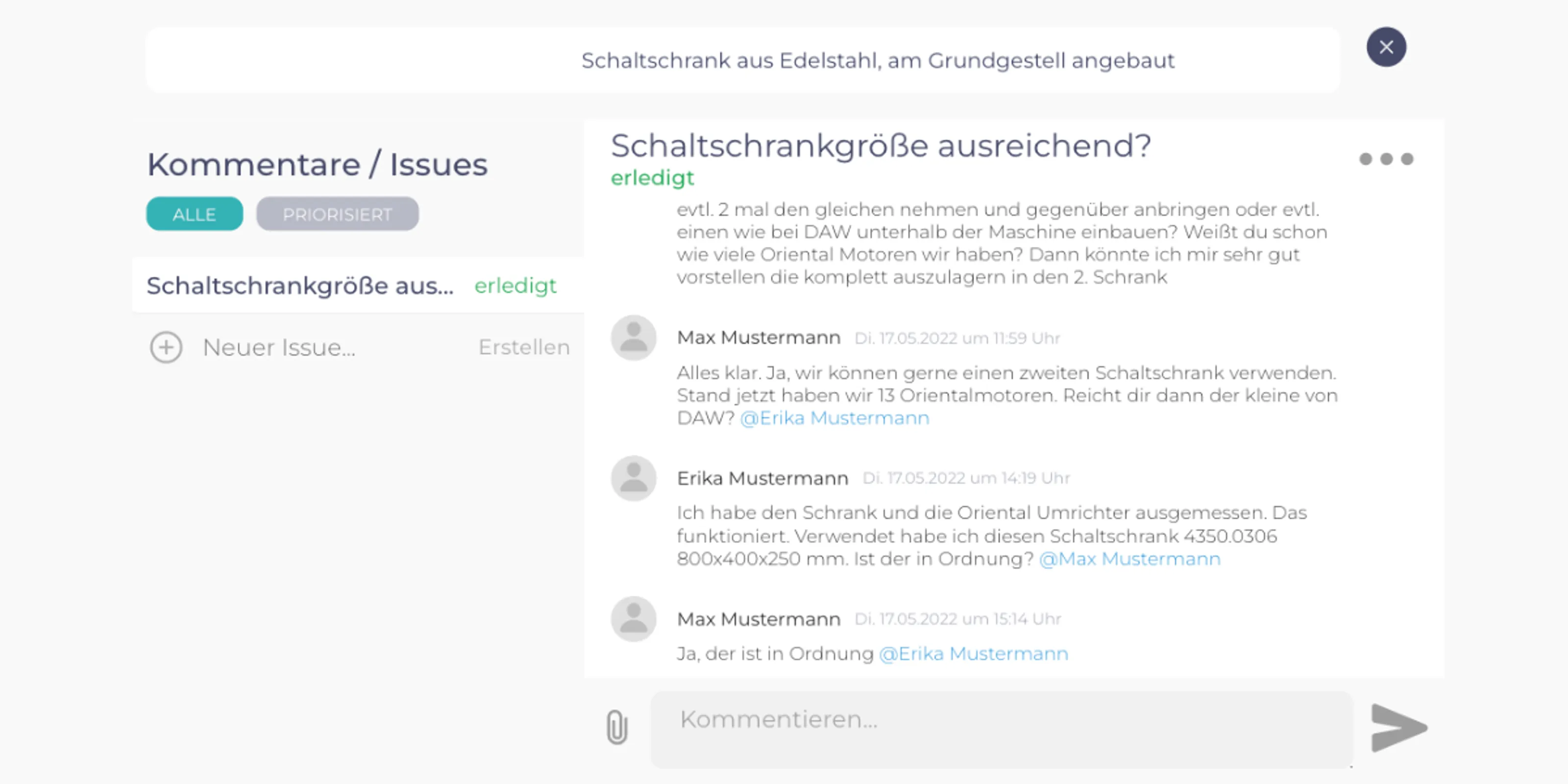
Questions and changes sit where everyone can see them: right at the assembly in the order. Whoever is responsible is addressed by name. What is open and what has been decided stays on record.
What a late change costs: rework, scrap, the delivery date
In special machine building, design work continues while production is already under way. The customer changes a requirement, something comes up during commissioning of the previous machine, a bought-in part is discontinued. Changes during a running order are not a mistake, they are part of the business.
It gets expensive when the change does not reach everyone. Design engineering has changed the hole pattern and updated the bill of materials. Production still has the old drawing, two parts have already been milled, and the bought-in part with the old article number has been ordered. The later it is noticed, the more depends on it: first rework, then scrap, and finally the delivery date.
On top of that comes the question of who told whom what, and when. The email went to the distribution list, the colleague from production planning was on holiday, and nobody on the shop floor read it. Your ERP knows the new revision, but it does not tell anyone that there is one.
The result
Changes in real time for planning, purchasing and production
One place for all questions and changes about an assembly. No circular emails, no notes stuck to the drawing, no walking round.
The clarification sits at the assembly
Not in a colleague’s inbox, but at the item in the order: “Is the control cabinet big enough?” is attached to the control cabinet. Whoever opens the assembly sees the question and the answer.
What is still open
Every point has a status. Open and prioritised points can be filtered. So before production or assembly starts, it becomes clear what has not yet been settled for an assembly.
Who decided what
Owners are addressed by name, every entry carries a date and time, and drawings and photos are attached. No more arguing about it afterwards.
Under the hood
No major project needed: an add-on to your ERP and your design data
We do not introduce a new system for design engineering. Orders and assemblies come from your ERP. The clarification sits exactly where your people look anyway.
-
1
Take over the order and its assemblies
Orders, assemblies and items come from your ERP. Nobody creates anything twice, and every point is attached to the real item, not to a description in words.
-
2
Record the question or change
Whoever needs to clarify something creates a point at the assembly and addresses the person responsible directly. The answer appears below it. Once the matter is decided, the point is marked as done.
-
3
Link it to the order data if needed
Where your data allows, we can add what a change in the order affects: what has already been ordered, is in production or has been built. Whether that is worth it for you, we find out in the potential analysis.
How we want to be measured
A goal beforehand, a check afterwards
Before we start, we agree with you on what should change, in one sentence your production manager would sign. For example: “Parts are only made to an old revision if someone has consciously decided so.” Or: “Purchasing hears about a change on the same day, not at goods receipt.”
At the end, we check together whether this has been achieved. If not, we keep improving, just as you do in your own customer projects.
Frequently asked questions
What you want to know about change management
Do you work with our ERP system?
Very likely. What matters is that we can get to the data: through an interface, the database or an export. If we do not know your system yet, we will say so openly and look at it together with your IT before we promise anything.
Our IT is already stretched. How much work will this mean for them?
Little, and it is predictable. At the start we need the necessary access from your IT and an agreement on your security requirements. Development and rollout are our job.
We still involve your IT from day one, because they should know what runs on their network. It takes work off their plate, too: every Excel list that disappears is one less query for them.
Do changes reach your shop floor too late?
Tell us where things get stuck. We will tell you honestly whether software pays off at that point and whether we are the right people for it.
Not quite there yet? Two-minute bottleneck check. No sign-up, no email address.